Book Trailer 101 Second Edition
 In the beginning (several years ago actually), The Writers’ Community of Durham Region asked me to present a workshop on how to create a book trailer. I was stunned that other than covering how to use specific video editors, there was nothing available about how to write and design a trailer. I found many sites on how to make a book trailer with iMovie or Animoto, but they discussed only the steps in assembling the video, not what goes into writing the trailer script. To me, this was like teaching how to use a power drill, then saying “You have the tool, now go build a house.”
Thus was born Book Trailer 101. “It’s never been done” is my call to action. The first order of business was to watch and analyze book trailers, and one thing became apparent quickly – only a few rose to the top. I also realized that effective trailers are more a product of imagination and creativity than the outlay of large sums of money.
I put out the word to writers I knew, as well as writing groups, asking for links to good book trailers. As I mucked through the coal, a few gems emerged. I looked for patterns in aspects such as the approach, and each time I discovered a new technique, I reassessed the trailer collection. I spoke to publishing professionals whose jobs are to oversee the creation of book trailers. As my analysis evolved, authors and creators offered me feedback and their opinions.
It became apparent that book trailers are a form of advertising. There are no hard and fast rules in advertising, but there are commonly accepted practices. Comparing the AIDA (Attention, Interest, Desire, Action) advertising principals to effective trailers yielded another dimension in my analysis. I showed my analysis to authors and publishers, and again, their feedback provided more insight.
The real eye-opener was teaching workshops. In my five-week course, the students walk through the process, creating their own book trailers. They learn a lesson in each class, then apply it for their own books as homework. By the fifth class, the students are showing and explaining the logic behind their trailers. The goal is not to have them create their final trailers, but to progress far enough that they can tune and continue to evolve their videos as needed.
- Second Edition online now
Amazon SimpleDB Developer Guide
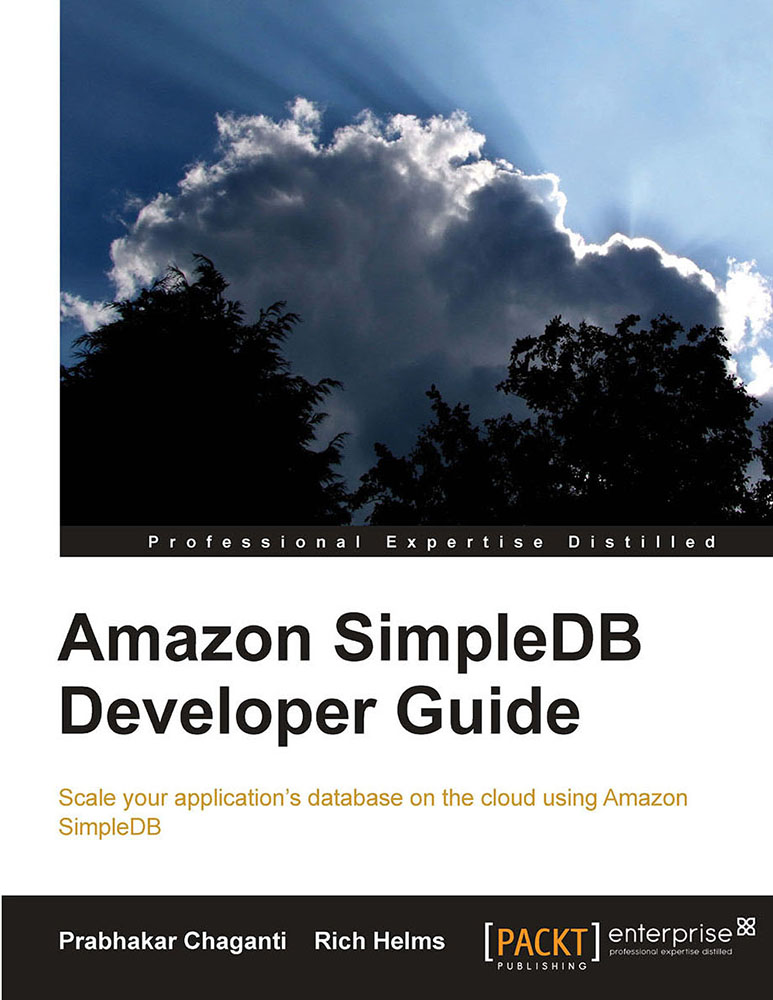 In 2010 Prabhakar Chaganti and Rich Helms wrote “Amazon SimpleDB Developer Guide” for Packt Publishing. Available from Packt Publishing, Amazon and other book retailers.
Description
SimpleDB is a highly scalable, simple-to-use, and inexpensive database in the cloud from Amazon Web Services. But in order to use SimpleDB, you really have to change your mindset. This isn’t a traditional relational database; in fact it’s not relational at all. For developers who have experience working with relational databases, this may lead to misconceptions as to how SimpleDB works.
This practical book aims to address your preconceptions on how SimpleDB will work for you. You will be quickly led through the differences between relational databases and SimpleDB, and the implications of using SimpleDB. Throughout this book, there is an emphasis on demonstrating key concepts with practical examples for Java, PHP, and Python developers.
You will be introduced to this massively scalable schema-less key-value data store: what it is, how it works, and why it is such a game-changer. You will then explore the basic functionality offered by SimpleDB including querying, code samples, and a lot more. This book will help you deploy services outside the Amazon cloud and access them from any web host.
You will see how SimpleDB gives you the freedom to focus on application development. As you work through this book you will be able to optimize the performance of your applications using parallel operations, caching with memcache, asynchronous operations, and more.
Gain in-depth understanding of Amazon SimpleDB with PHP, Java, and Python examples, and run optimized database-backed applications on Amazon’s Web Services cloud